Common Name: striped American agave
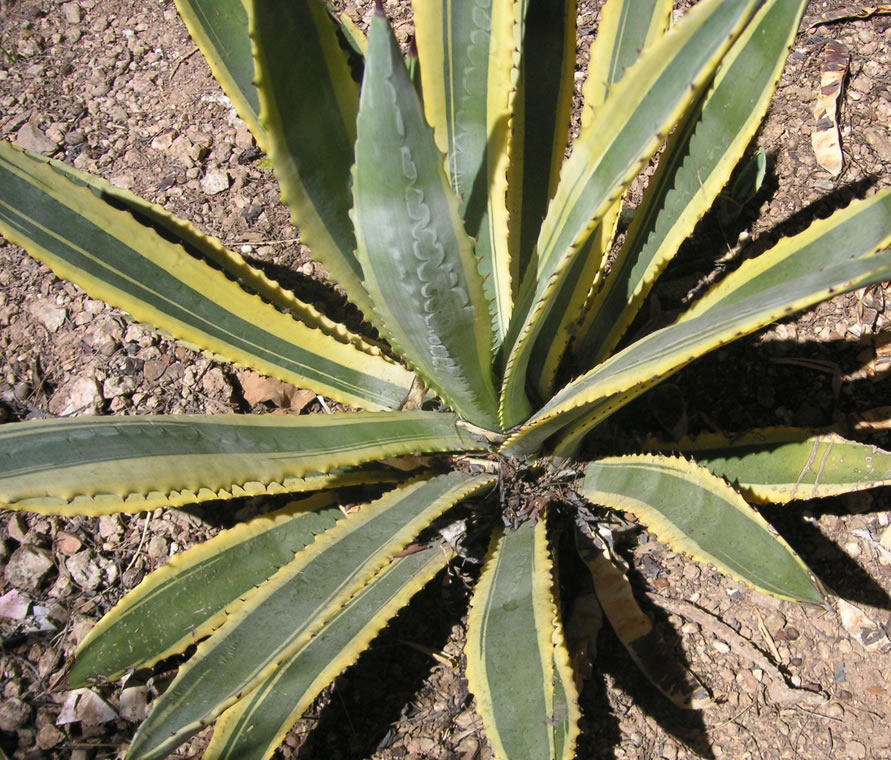
Characteristics: Agave americana var. marginata – variegated century plant The variegated century plant is a large, evergreen, succulent, slow growing plant that grows up to 1-2 m (4-6 feet) high and 2-2.5 m (6-8 feet) wide. This plant produces a single trunk with leaves arranged in a round, open, rosette. Leaves are twisted, and silvery-green with stripes of bright yellow along the leaf margins. Leaves are lanceolate/sword-like, < 2m long, 25 cm wide, somewhat stiff upright, and they terminate with a spiny tip and are flanked on the margins with small brown hooks. The long leaves tend to bend and fold back on themselves giving the appearance of a striped ribbon. Pale yellow-green flower are produced on a stalk only once in its lifetime, after ten to twenty years of growth. After blooming, the mother plant begins to senesce and die. Fruit is oval, 3-8 cm (1-3 inches) long, dry, hard, brown and persists on the plant
Geographic Origin: Mexico/ Desert Southwest
Natural History: Agave americana originates from Mexico and has since been distributed in areas including the United States, Mediterranean, Europe and Africa where it is used as an ornamental. It poses little risk for becoming invasive
Cultivation Notes:
Ethnobotany: Variegated century plant is common in cultivation as an exceptional ornamental plant. It provides a dramatic yellow, architectural accent in the landscape and often used in rock gardens and xeriscaping.
The sharp spine at the tip of its toothed leaves can be removed to reduce risk of injury to people and pets and it should be placed in a landscape at least six feet away from traffic.
Agave americana is also used for its high fiber content in and as a food source by Sonoran natives
Height: 6 – 10 feet
Width: 6 – 10 feet
Growth Rate: Slow Growing
Grow Season: Summer
Flower Season: Summer
Color: Yellow
Function: Accent
Spread: Spreading
Allergen: Non-allergenic
Invasive:
Toxicity: Benign
Hardy: Tender
Water Use: Low water Use
 Plants of Wade Rd